
The Elements of Joy
Contemplating land-as-healing in Japan and Hawaiʻi


In the late 1930s, after a bout of exhaustion and pneumonia, a young agricultural research scientist named Fukuoka Masanobu sat on a hillside overlooking the harbor in Yokohama. He reports having spent the night sitting against a tree, neither awake nor asleep. He was in a desperate condition, physically, mentally, existentially. But with the rise of the morning mist and the “sharp cry” of a night heron, he says, in an instant all his doubts and confusions vanished:
I could see that all the concepts to which I had been clinging, the very notion of existence itself, were empty fabrications. My spirit became light and clear. I was dancing wildly for joy. I could hear the small birds chirping in the trees, and see the distant waves glistening in the rising sun. The leaves danced green and sparkling. I felt that this was truly heaven on earth. Everything that had possessed me, all the agonies, disappeared like dreams and illusions, and something one might call “true nature” stood revealed. [1]
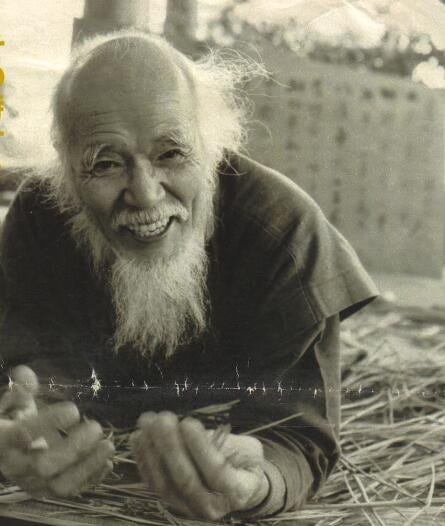
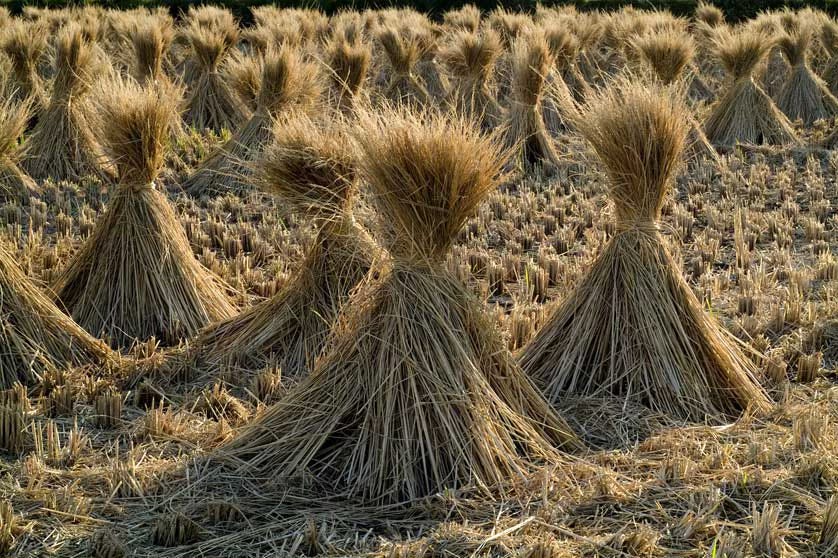
The next day Fukuoka quit his research position and returned to his family farm and citrus orchard in a rural southwest region of Japan called Ehime. There he put his awakening experience into agricultural practice and over the next fifty years developed a philosophy called natural farming (shizen nōhō) that would spread to places as far as the UK, from where I write, to Hawaiʻi, where I first learned of his work.
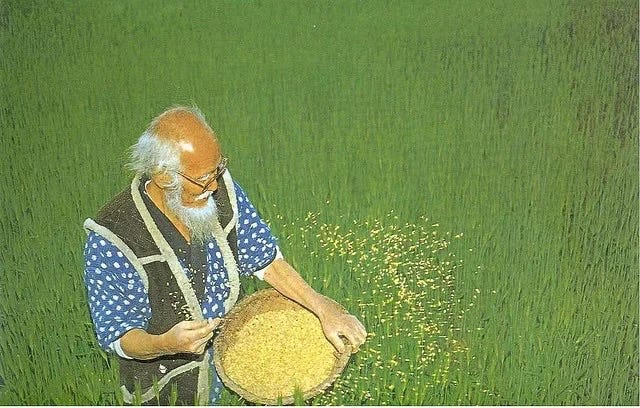
Today, many people in Japan and beyond who feel exhausted by post-industrial lifestyles have turned to land to heal. Along the way they have encountered work by Fukuoka and others that describe profound direct experiences with nature. With resonances with other modes of farming in partnership with natural environments—permaculture, macrobiotics, nature farming, Korean Natural Farming, and a wide variety of Indigenous and ancestral practices of relating to land as alive—his ideas have contributed to a global cluster of land-based philosophies inspiring people who in times of loss, pain, trauma, and crisis are finding joy in the elements of earth.
Joy in the Metacrisis
In recent decades, ecological crises have raised the consciousness of existential threats in Japan: soaring summer temperatures, rising pollen allergies, increasing storms, and the enduring environmental effects of the March 2011 triple disaster of earthquake, tsunami, and nuclear fallout. Combined with ongoing social instability in the form of economic stagnation, employment precarity, loneliness, and an aging but shrinking population most affecting Japan’s rural landscapes, multiple challenges have created what some describe as a metacrisis. Metacrisis refers to intersecting insecurities that cascade between local and global scales. These crises are complex and therefore hard to track conceptually. But when they manifest in nature, such as in a flood, drought, dying crops, or irradiated infrastructure, they also register in bodies (as sickness, stress, burnout) that are similarly composed of nature’s elements.
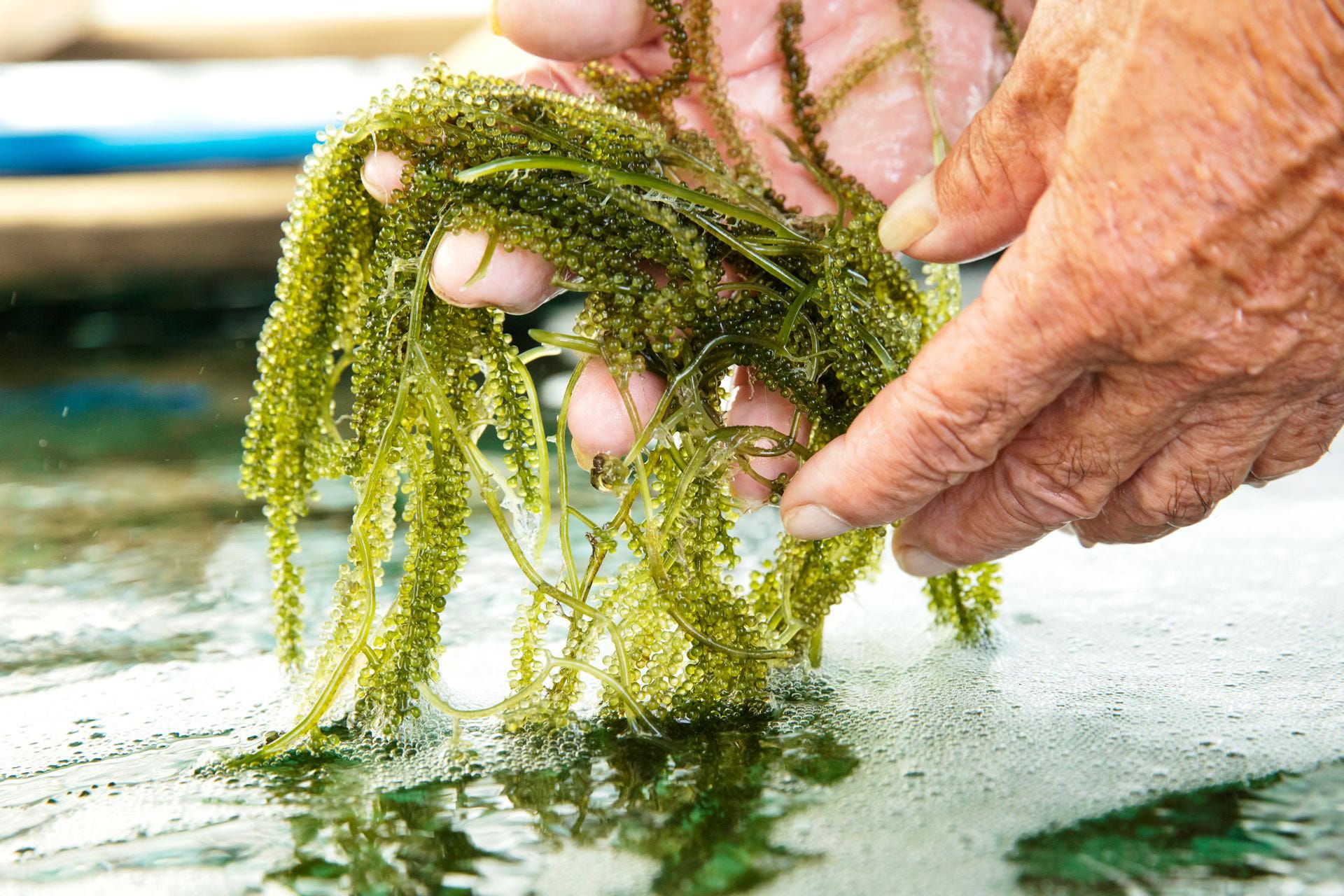
In response, many in Japan have turned away from the failed promises of mainstream modern society and sought refuge in nature-based philosophies. These come from Japan’s Shintō and Buddhist traditions, but also from Indigenous practices from Japan’s neighbors such as Okinawa and Hawaiʻi, whose histories have long been entangled through legacies of Japanese and American colonization. In practices such as Buddhist-inspired methods of natural farming (Japan), localized modes of coastal care and seaweed cultivation (Okinawa), and Indigenous projects in native agroforestry (Hawaiʻi), people are demonstrating how experimental farming and other ecopractices that attend somatically to the shared elements of human-nature reciprocity can heal selves and communities in times of disconnection. Most of all, they are finding joy not just in the land but also in each other’s traditions that transcend cultural borders.
Research on and through Joy
In the Elements of Joy project, part of a cross-cultural study on joy in times of crisis, collaborators and I apply ethnographic methods to learn what joy as a mode of feeling can teach us about the interdependence of human-ecosystem health. This involves interviewing, participant observation, and simply doing what others do such as training alongside natural farmers at sites in Kyoto and Ehime, Japan; cleaning coral beds and seaweed gardens as part of coastal stewardship in Okinawa; and clearing non-native plants from forests that make up part of a community-led public health center in Hawaiʻi.
However, this also involves contemplative methods by which my collaborators connect with land directly: meditation, harvest offerings, water absolutions, and prayers and chants offered to elemental forms of earth (kami, akua) before entering a garden. Most of all it means being led by joy and its serendipities as a mode for seeing human-nature connections more clearly.
This is counterintuitive for many scientists who are trained to see emotion as inimical to objective research. But for many of my collaborators emotion is integral to knowing land. If one does not feel joy or even love for land, love for “that which feeds” and cares for us (aloha ʻāina in Hawaiian traditions), one can neither see its needs nor meet them well.
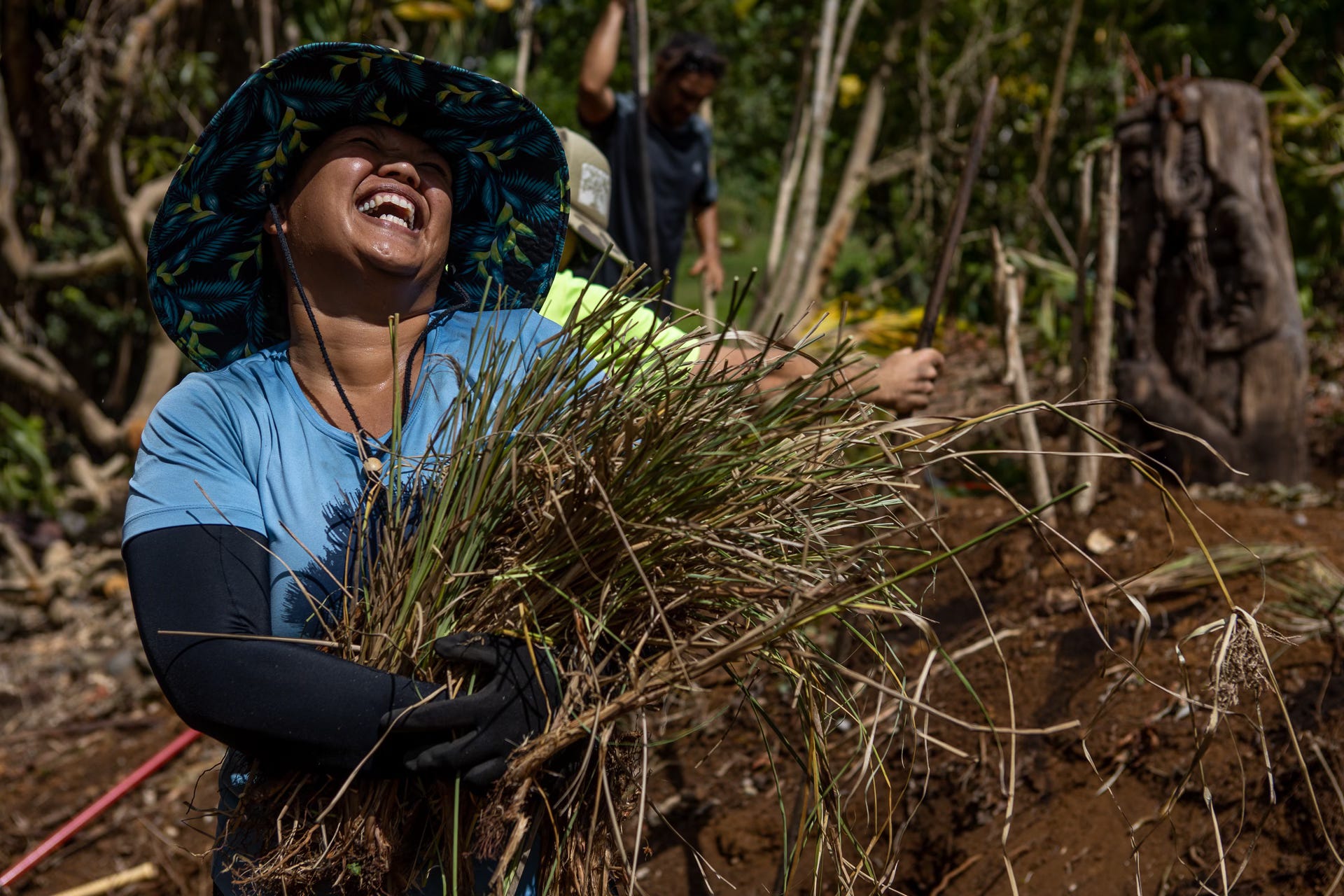
From this point of view, joy might be a critical missing or simply misplaced piece of coping well with climate crisis, its effects, and scientifically objective means for monitoring it. Imagine what more could be seen of earth when seen in joy! According to Fukuoka’s experience (above), joy was a natural result of seeing nature clearly. In turn, many meditators and natural farmers who report similar experiences say that joy is not only a result but a method—the very practice by which they cultivate direct insights into nature. From their perspective, and resonating with many Indigenous views, joy kindled with and through the elements of earth teaches how nature itself grows, farms, thinks, or even in its own abstract way contemplates.
Why Japan-Hawaiʻi Connections
Many anthropology projects focus on single sites—Buddhist nuns or schoolboys in Thailand, bitcoin in Tel Aviv, or pop-culture-managing bureaucrats in Japan, to cite sample projects by AnthropoloJOY’s team members. But there are usually at least two perspectives at operation in these projects, that of university researcher and researched. In contrast, this project purposefully troubles that dynamic so not all its findings are validated through academic cultures of mostly Western philosophy. Instead, I think through the stories, words, and structures of feeling that people have generously shared with me while living and working for over 20 years between Japan and Hawaiʻi.
Japan and Hawaiʻi share deep and often troubled histories cast against the foreground of American empire still active in the Asia-Pacific today. In 1868, the year of Japan’s Meiji Restoration/Revolution, 150 Japanese migrant laborers arrived in the independent Kingdom of Hawaiʻi to work on sugar plantations. They lived alongside Native Hawaiians whose population of at least 300,000 in 1778 (and possibly closer to 800,000 prior to European contact [2]) had been reduced to 71,000 in 1853 [3]. As historian Ronald Takaki describes, population followed patterns of monocrop labor recruitment. By 1920 Japanese immigrants represented around 43% of Hawaiʻi’s population and Native Hawaiians around 16% [4]. In 1893 Queen Lili’uokalani would be illegally removed by a group of American sugar plantation owners, businessmen, and marines. America annexed Hawai’i in 1898 and in 1959 residents voted—against many Native Hawaiian voices—for statehood [5]. Today, Japanese, Hawaiian, and other peoples from the Asia-Pacific living in Hawaiʻi share traditions and mixed ancestry. But traumas of Native Hawaiian dispossion of land, language, and culture run through the living landscape.
Under these historical legacies it seems hard—even wrong—to think through joy. And yet as colleagues and collaborators in Hawaiʻi have taught me, aloha as a practice of relating to land, family, and others has always guided action, even in its fierce modes of defending homeland [6-7]. And even when it felt largely betrayed by outsiders [8]. In this regard, it seemed impossible to undertake a cross-cultural project on joy in times of crisis without collaborators from Hawaiʻi, given the island’s grasp on the hearts and global imagination of so many of its visitors, not least of all from Japan and, like me, America, whose mutual influence, and therefore responsibility, cannot be escaped (see article linked in callout below).
Why I Study the Elements of Joy:
An invocation for research in relation, reciprocity, repair
By working against the traditional academy-field site relation, and choosing an atypical affective mode of work—namely joy over doubt, skepticism, and suspicion—the Elements of Joy project also aims to undo less helpful and solitary habits of academic thought—a kind of affect as cultural critique. For example, there is often a moment when the traditional fieldworker, trained to find data and publish (or perish), feels obliged to render a particularly magical moment of fieldwork or meaningful relation into an idea for an article, book, or dare I say, a Substack post. Elements of Joy seeks to break these habits that sometimes feel extractive and create space for new research outputs as yet unimagined. Most directly it aims to do so through collaboration and reciprocity, and by following and supporting creations that our collaborators find most uplifting, meaningful, and joyful.
Does joy in and of the natural elements guide your own work, life, play, or activism? Would you like to share on your own terms and authorship? If so, please get in touch at the links below!
References
[1] Fukuoka, Masanobu. 1978. The One-Straw Revolution: An Introduction to Natural Farming. Emmaus, PA: Rodale Press, 28.
[2] Office of Hawaiian Affairs, Research Division, Demography. 2017. Native Hawaiian Population Enumerations in Hawaiʻi. Honolulu: Office of Hawaiian Affairs.
[3] Ronald Takaki. 1983. Pau Hana: Plantation Life and Labor in Hawaiʻi, 1835–1920. Honolulu: University of Hawaiʻi Press, 22.
[4] Ronald Takaki. 1983. Pau Hana: Plantation Life and Labor in Hawaiʻi, 1835–1920. Honolulu: University of Hawaiʻi Press, 28.
[5] Haunani-Kay Trask. 1999. From a Native Daughter: Colonialism and Sovereignty in Hawaiʻi. Rev. ed. Honolulu: University of Hawaiʻi Press, 4–21.
[6] Haunani-Kay Trask. 1999. From a Native Daughter: Colonialism and Sovereignty in Hawaiʻi. Rev. ed. Honolulu: University of Hawaiʻi Press.
[7] Ty P. Kāwika Tengan. 2008. Native Men Remade: Gender and Nation in Contemporary Hawaiʻi. Durham, NC: Duke University Press.
[8] Silva, Noenoe K. 2004. Aloha Betrayed: Native Hawaiian Resistance to American Colonialism. Durham, NC: Duke University Press.
Fascinating post. Looking forward to following the work!